
Some of the most common questions patients ask me about colonoscopy are when to have one, whether it is painful and what to expect before and after the procedure.


Who needs a colonoscopy?
Everybody needs a colonoscopy at some point in their adult life! Did you know that Singaporeans have a 5% lifetime risk of developing cancer? This risk increases as we age! As with any cancer, the outcome or prognosis is better when it is detected at an early stage.
With regular colonoscopy, we have the ability to survey the colon for early cancers and biopsy them before an actual surgery. Better still, the detection of polyps during colonoscopy enables the problem to be ‘nipped in the bud’ (literally!).
This is because colorectal cancers are thought to originate as small polyps that eventually undergo malignant transformation into cancers.
Do I need a regular scope check-up? How often should I do it?
The Health Promotion Board recommends a screening colonoscopy for everyone above the age of 50. For any individual who has a first-degree relative with a history of colon cancer, the recommendation is to do a colonoscopy 10 years prior to that index case.
Beyond the first screening colonoscopy, the frequency is dictated by:
- Presence of symptoms such as bleeding in the stools, change in bowel frequency or consistency.
- Presence of polyps (type, size & number) found in the previous scope.
It’s good to have a discussion with your surgeon about the need for a colonoscopy and how often to repeat it.
What can it do for me? Treat cancer?

Colonoscopy is the best way to detect polyps and cancers:
Scans such as CT colonography and barium enema may not be sensitive enough to pick up tiny polyps. Through a scope, a surgeon can both view and biopsy (take a sample) for histology. This is crucial for confirming the diagnosis before an actual resection surgery is recommended.
Other than diagnosis, the colonoscope may sometimes be used to treat rectal cancer when it is at its earliest stage (T1). This is feasible via a highly specialised technique known as endoscopic mucosal resection (EMR) or endoscopic submucosal dissection (ESD). Not every early cancer is suitable for this endoscopic resection though.
Can I request for this procedure for a peace of mind?
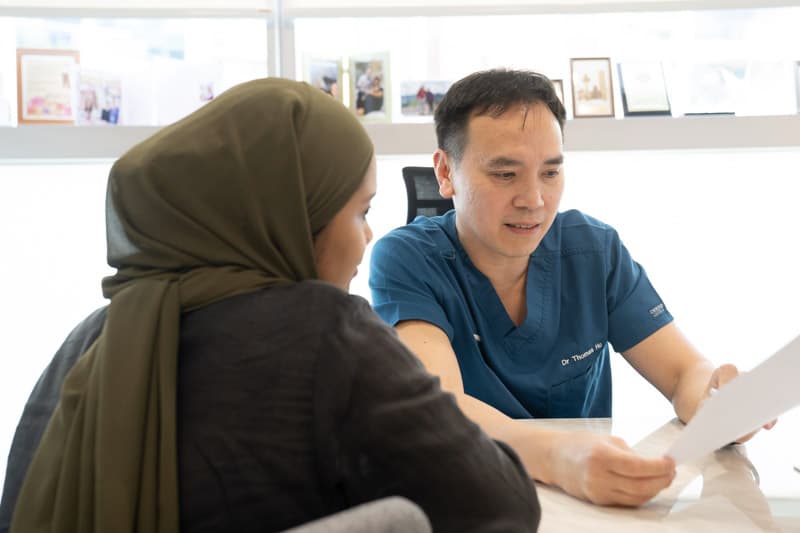
There are many reasons why an individual may request a colonoscopy even though he may not have any symptoms. The most common reason is a positive family history of polyps and/or colonic cancer.
Ultimately, whatever the reason, a normal colonoscopy can certainly provide a peace of mind. Nevertheless, a colonoscopy is not without risks, so be sure to discuss all the potential risks and benefits with your surgeon.
Some common questions
Is colonoscopy a common procedure in Singapore?
A colonoscopy is one of the most common procedures performed among Singaporeans. This is in part due to an effective public health campaign towards awareness of colorectal cancer.
I’m sure that amongst your relatives, friends and colleagues, there will be at least a couple of them who have undergone a colonoscopy.
As mentioned earlier, some people do need to have a repeat colonoscopy because of abnormal findings or the emergence of new symptoms.
Is colonoscopy a surgery? Will it be covered by insurance?
A colonoscopy and gastroscopy do not involve traditional open surgery. However, colonoscopy is assigned a surgical code and table, similar to other surgical procedures.
As a recognised surgical procedure, colonoscopy is typically covered by government subsidies as well as national and private insurance, subject to eligibility and your insurance policy.
Is colonoscopy an uncomfortable procedure? Can I be under GA?
A colonoscopy is usually performed under sedation, with most patients asleep and comfortable throughout the procedure. An anaesthetist may be present to administer and monitor the sedation.
General anaesthesia (GA) is rarely necessary, as sedation is usually sufficient for a colonoscopy. Depending on the level of sedation, some patients may have brief awareness of discomfort, such as abdominal bloating, but this is generally minimal and should resolve after the procedure.
Have concerns about undergoing a colonoscopy?
It is completely normal to have concerns about undergoing a colonoscopy. Contact us if you have any questions about the procedure, sedation or what to expect. Our team will be happy to guide you through the process.